Baby who died at CUMH shortly after birth did not receive blood for 22 minutes, inquest hears
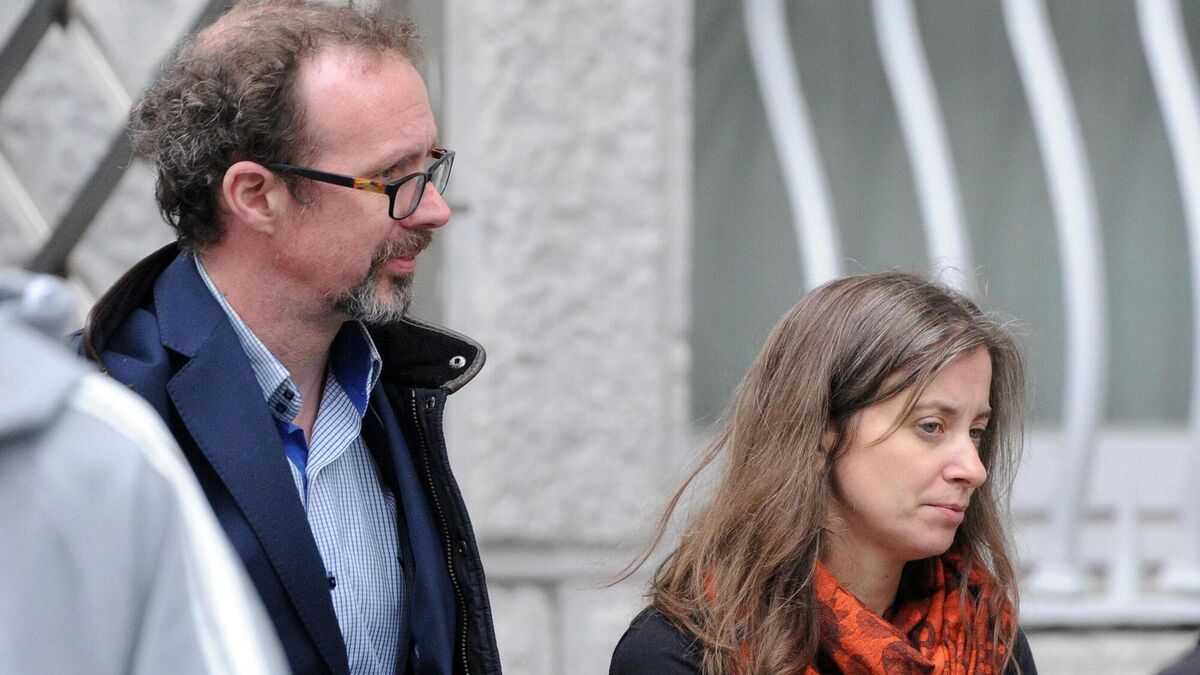
Lisa and Sean Moynihan outside Cork Coroner's Court.
A BABY who died shortly after birth in Cork University Maternity Hospital (CUMH) did not receive blood for some 22 minutes despite being born very anaemic and acutely unwell, an inquest has heard.
Concerns were also raised that when an emergency call was made for help resuscitating baby Tom Luke Moynihan, the consultant on call did not receive that first emergency call for help.
Baby Tom was born “extremely pale” and his heartbeat was not detected after he was delivered by emergency caesarean at 6.43pm on May 27, 2016, the inquest at Cork Coroner’s Court has heard.
His mother, Lisa Moynihan, had noticed blood running down her legs and found herself standing in a pool of blood while at work following a substantial painless unprovoked antepartum haemorrhage.
She was brought to CUMH by ambulance where an emergency caesarean section was performed as her baby’s heartbeat had dropped dangerously low.
At 6.43pm, Baby Tom Luke was delivered. He was pale and no fetal heartbeat was detected. Work began to resuscitate the baby and staff midwife Fiona Coady activated the hospital emergency telephone number requesting a full neonatal team to attend the theatre.
Consultant Anesthetist, Dr Mary Walsh, who attended to both Baby Tom and his mother that evening, said that the baby looked like “he had lost a lot of blood” which would suggest that fluid was needed urgently.
Saline was administered while they waited for blood to arrive. Blood was administered at 7.05pm.
Baby Tom was pronounced dead at 7.17pm.
The baby’s heart rate had been ‘on the floor’ and his mother had suffered a painless substantial antepartum hemorrhage – all significant warning signs – barrister for the family and partner and head of the Clinical Negligence Unit of Callan Tansey Solicitors, Roger Murray SC, said.
Blood tests showed haemoglobin (HB) at 10.5, which denotes anaemia and can suggest significant blood loss.
Yet, it took some 22 minutes to get him blood, Mr Murray said.
The inquest heard that blood is not kept locally in CUMH. It is instead kept centrally at the blood bank in the main Cork University Hospital.
Dr Walsh said that it can take some five minutes to get blood products from the blood bank in Cork University Hospital to CUMH.
But Dr Walsh and a number of midwives noted that 0 Negative blood, which is generally considered safe for all blood types, was always kept in a fridge in neonatal theatre in the former St Finbarr’s and Erinville hospitals and could be given "instantaneously".
Concerns were raised by staff at the time about the emergency call system. Carmel Lehane, Clinical Midwife Manager in the obstetric theatre at the time, suggested that a consultant should either be automatically included in the emergency response team, or that someone calling for help should be asked if a consultant is required as part of the emergency response team.
The inquest heard that shortly after Baby Tom’s death, a new system was introduced so that when someone makes an emergency call for help within the hospital, the receptionist will ask the caller whether they want a consultant as part of their emergency response team.
The Moynihans were promised a review at the hospital following the baby’s death. But for six years they heard nothing, Mr Murray said.
But a letter sent on Tuesday, September 12, from Mairead O’Riordan, Clinical Director at CUMH, extended “deepest sympathies” to the Moynihan family.
“Whilst we did review the care of Ms Moynihan and Baby Tom in a number of fora, which led to a change in practice, the formal internal review was not carried out," the letter said.
Receiving any response was of some solace to the family, Mr Murray said.
Mr Murray said that Mrs Moynihan had had a “trouble-free pregnancy”, diligently attending all antenatal appointments and GP visits. Tom was her first baby.
The Moynihan’s nightmare began when at 36 weeks and two days pregnant, Lisa Moynihan “felt something pop inside her” while she was at work serving a customer.
When she looked down, she was “standing in a pool of blood" but she felt no pain.
An ambulance brought her to hospital on May 27, 2016, at approximately 5.50pm.
“A nurse checking my son’s heartbeat said she could hear his heart beating and it was strong, to which I replied ‘that’s music to my ears,’” Mrs Moynihan said.
But then “things took a very sudden turn,” she said.
"I was told that I was going for an emergency caesarean and that I needed to be put under straight away. I thought that something was wrong with me and that I was going to die.
“When I woke up, I found Sean [her husband] standing over me with tears in his eyes saying how our son didn’t survive. I couldn’t believe what I was hearing, his heart was beating, he was healthy. I started to shake, I was in shock.”
Their “beautiful boy” was still warm when his father, Sean Moynihan, held him at the hospital.
The Moynihans were told that Mrs Moynihan had suffered the rare condition vasa praevia.
In vasa previa, some fetal umbilical cord blood vessels run across or very close to the internal opening of the cervix.
These vessels are unprotected by the umbilical cord or the placenta and are therefore at risk of rupturing when the membranes break.
If the membranes tear during labour, the blood vessels might also tear with the baby potentially losing a life-threatening amount of blood.
It is also possible that when the baby drops into the pelvis, the vessels may be compressed, affecting its blood supply and causing oxygen deprivation.
A low-lying placenta is one of the risks for this condition.
The inquest in front of Philip Comyn and a jury of five women and one man, continues.






 App?
App?


