The spirit of giving has a long tradition in Cork
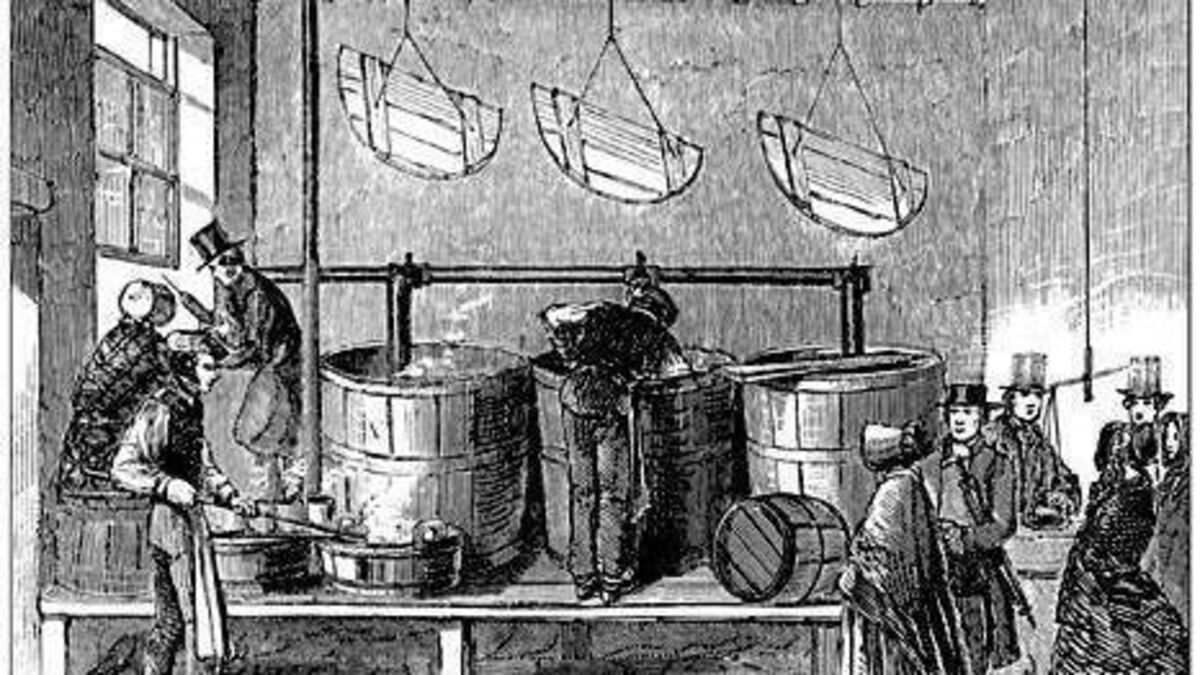
Cork’s Quaker Soup Kitchen in Barrack Street where Fr. Mathew served the poor and destitute of Cork during the Famine of 1847. Courtesy: Illustrated London News, January 16th 1847, Cork City Library.
The great tradition of philanthropy in Cork has strong and deep roots dating back to medieval times.
Prior to 1838, no state-operated scheme existed to relieve the misery and hardship of the destitute in Ireland. However in 1817, after seeing the appalling state of the poor in Cork, people of goodwill were driven to come together to form a “General Committee for the Relief of the Poor”.
Committees were established in each parish in order to ascertain the conditions of the poor and the reasons for their plight. In that year Cork was described as “the most distressed part of Ireland”.
When the committee's report was finally completed and presented three years later, its stark findings revealed some very alarming statistics.
It stated that out of a total population of 100,000 persons in the city and suburbs, over 20,000 were unemployed and starving. These statistics accurately reflected the bleak reality that the streets and lanes of Cork were swarming with the poor and destitute. There were many thousands however who did not publically parade their misery on the streets. One report stated that “the poor in Blackpool have accepted their misery with extraordinary resignation” despite, at the time, great advances in industrial and technological development.
In the dark and dreary damp, cold, overcrowded rat-infested tenements, families resided or rather existed. Many of them were street dealers who tried to earn enough to keep a roof over their heads, food in their bellies and the cold from their bones.
Large families were the norm in those days. It was not uncommon to have fifteen children in one family. On reaching four years of age, these deprived children would be forced onto the streets to beg while the older ones would sell wares like their parents. Due to malnutrition and failing health, many of the dealers had just enough energy to sit outside the door of their crumbling tenements to sell wares. It wouldn’t be long though before they’d be ordered by the authorities to move onto the established Corporation Markets located around the city and suburbs.
The eminent Historian, CJF McCarthy tells us: “In old Bridewell Lane, off North Main Street by Castle Street stood thirteen dwellings and they housed 206 persons, some of the rooms that the people lived in would have been six feet by four, popularly called ‘coffins’."
Within a radius of a hundred yards of Castle Street, thirteen hundred people lived. These figures give us a clear insight into the atrocious living conditions experienced by Corkonians at the time.
The Poor Law Scheme was only in operation a few years when the Great Famine sunk its fangs into the heart of the nation, ravaging its people, especially the poor.
On February 1st, 1847, the reported that: “The number of country people that crowded into Cork to escape from the more dreary starvation on the fields and villages are so great and their poverty is so complete, that they cannot find where to lay their heads at night under any roof in the city. The miserable strangers are obliged to live in doorways and under sheds."
Another report states: “A devastating fever enveloped the city, it knocked on every door, especially those of the poor who lived in the squalor of the rat infested overcrowded tenements on the narrow filthy lanes and alleyways, which invariably became a breeding ground for the ‘Famine Fever’ as it was so named.”
To ease the terrible misery and suffering of the people, charitable organisations and soup kitchens were established and Fr Mathew, the great temperance leader, could be seen serving the poor in one of them on Barrack Street.
In the wake of the Great Famine, the country’s population had shrunk considerably. The 1851 census tells us that the population had decreased to 6,500,000 compared to 1845 when there were two million more. The general consensus was that about one million people had died and another million had emigrated.
Poverty was still as rampant as ever in the streets and homes of Cork City and food riots were a common occurrence. Workhouses were heaving with poor souls who had nowhere else to turn while those who could afford a ticket to another county emigrated. The cheapest passage from Cork to America in 1847 was 3 pounds 15 shillings.
It was nice to see the victims of the Great Famine remembered throughout the country on Sunday, May 17th 2009 at the first National Famine Memorial Day Commemoration organised by the government.
Despite their plight, Corkonians always looked on the bright side of life. They may have had very few worldly possessions but what they had, they shared with each other. A happy bunch, full of the gift of the Blarney, their bleak circumstances did not hamper their sense of fun and passionate love of music and song. In many of the little cottages they inhabited as well as the crumbling dilapidated tenements that dominated the city landscape, heartfelt singing could be heard as well as the sweet sound of music. Even the urchins on the street would whistle the airs of new operas while buskers could be seen at every street corner.
In the 18th century, the Historian, Charles Smith had the following to say regarding the Corkonian’s love of music: “Besides the public concerts, there are several private ones where the performers are of such good skill that one would imagine the gods of music had taken a large stride from the continent over England to the streets of Cork."
When the National Education Board was established in 1831 by Ireland’s Chief Secretary, Lord Stanley, in order to provide a network of national schools throughout the country, education was free but not compulsory which meant that parents could send their children to work instead of school.
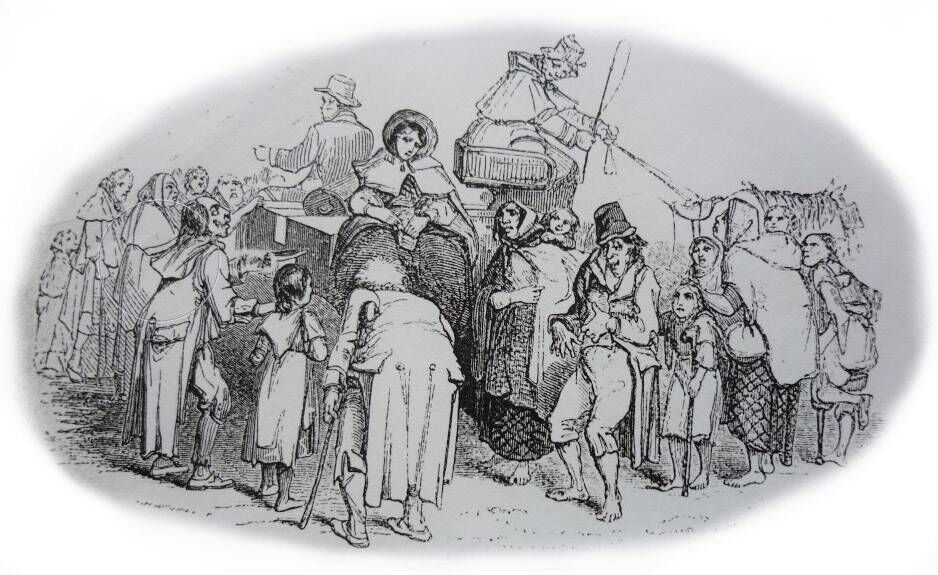
At the dawn of the 20th century, there were about nine thousand children of school-going age in our City of Cork. Most went to school hungry, barefoot and half-naked, some from one-parent families and drunken violent homes. After school, many children from five years of age upwards resorted to begging or robbing. A few of the lucky ones had a part-time job. One of the most popular jobs for children in Cork at the time was selling the Evening Echo. Established by the Crosbie family in 1892, this very popular publication could be bought for one half penny and was considered a good omen by the social reformers of the day as it helped children turn their backs on begging and robbing.
Each day, scores of children would descend on the Echo office to collect their quota of newspapers and off they would go to their spot, be it on a street corner, in the middle of a road or under a gas lamp. Standing in all kinds of weather, many were barefoot as they would shout aloud the immortal words: ‘Echooo, Evening Echooo’.
By 1902, these children could earn up to eight shillings a week solely selling the Echo. This source of financial security often ensured that they would have a less abusive life and that their parents and brothers and sisters could have the comfort of a hot meal or fuel to build a fire on cold winter evenings.
As a young kid growing up in Cork City I always longed to be an Echo Boy. Whenever my Mam and Dad would bring my two brothers and I into the heart of the town, I remember how star struck I was anytime I laid eyes on one of Cork’s famous Echo Boys. Standing so proud with head held high and chest out, the Echo Boy would cradle a big bundle of ‘Echos’ under one arm and wave another rolled up ‘Echo’ like a baton as if conducting a large choir to follow the legendary chant which captured me and the passersby. They looked like those film stars on the silvery screen at the Assems and the Lido. I still get that warm feeling today when I hear those magic words: ‘Echooo, Evening Echooo’. [now called ]
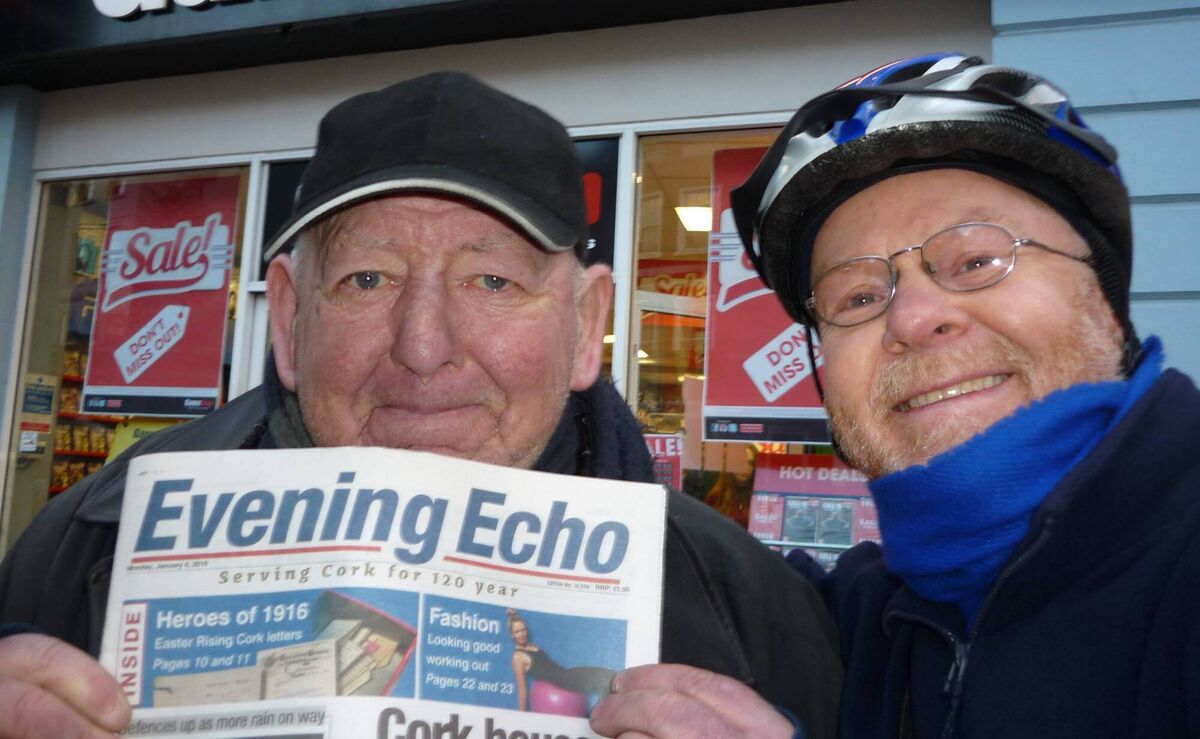
In 2003 my wish finally came true when Cork’s famous Echo Boy, Michael O’Regan ceremoniously handed me his precious bundle of ‘Echos’ and together we chanted the famous Cork words: ‘Echooo, Evening Echooo’. As I stood on Pana embracing the sacred Echos – the Cork Bible - enthusiastically cheered on in the century long tradition by Michael and a group of friends, I felt the spirit of all the Echo Boys with me at that moment – I thought I was a little boy again as I shouted at the top of my voice ‘Echooo, Evening Echooo’. I felt so proud to be a Corkonian.
It’s interesting to know that in 2018, the and as well as other titles owned by the Landmark Media Group were taken over by the Irish Times and in March, 2019, the became . Today the Echo Boys still chant the familiar phrase: ‘Echooooo….. Echooooo…..’






 App?
App?


