‘Our audience has got younger’: Cork storytelling festival is back
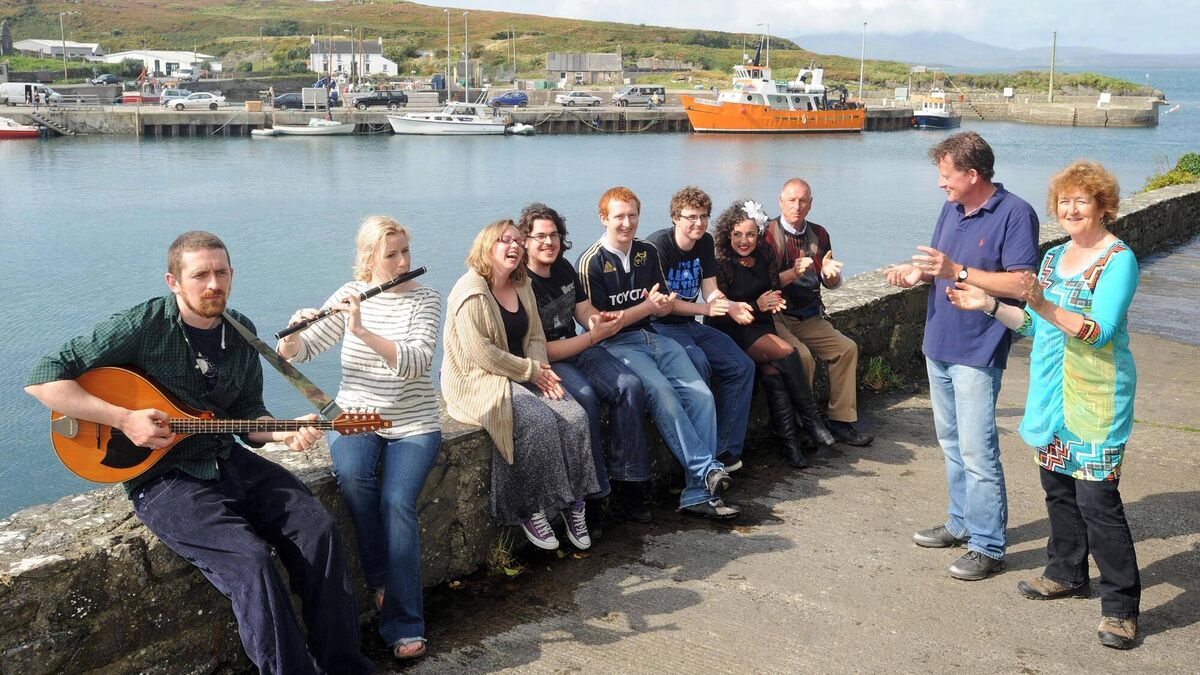
Diarmuid Ó Drisceoil and Liz Weir with some of the storytellers at the 2024 Cape Clear International Storytelling Festival. Picture: Denis Minihane.
For the past three decades, some of the world’s best storytellers have headed to an island off the Cork coast to perform.
Now the Cape Clear International Storytelling Festival is returning from September 4-6 for its 32nd year.
There have been a few changes down the years.
“The old coláiste was hot, it was airless,” remembers Diarmuid Ó Drisceoil, a Cork writer, historian and storyteller with deep family ties to the island.
“The tellers loved it, the MCs loved it, the audiences loved it. We used to get up to around 275 people in there. Every square inch of space taken, so the front row of the audience was about two-and-a-half feet from the teller. Mad stuff, but wonderful.”
The festival was founded by Chuck and Nell Krueger in 1994, and has grown into one of the most renowned, innovative and finely curated storytelling events in the world.
Americans Len Cabral, Dovie Thomason, and Joel ben Izzy are just some of the names who have headlined the festival, alongside well-known Irish storytellers like Eddie Lenihan.
From the outset, the festival blended Irish speakers with talent from abroad.
“There was always an American teller, a European teller, a teller from, say, the UK, an Irish teller,” says Diarmuid.
“The international element was always important, and it gave Irish tellers and aspiring Irish tellers a chance to see how it worked in other countries, with other traditions.
“I suppose it gave people confidence, that we can be as good as the best of them.”
Providing a diverse line-up was central from day one.
“In the olden days it was men, men, men,” remembers Liz Weir, a storyteller from County Antrim and a founding committee member of the festival.
“When I started telling stories, people wanted the old ha-ha jokes. There was a lot of sexism. I was trying to counter that.
“Storytelling is the most democratic of art forms. Some people like personal stories, some people like historical stuff. We like myths and legends, we like folk and fairy-tales. We’ve always had a musician every year.
“We’ve also always had Irish language, of course, because Cape is a Gaeltacht island.”
The festival grew organically through the 1990s and 2000s, a loose initial format becoming steadily more structured.
“We were there the year Princess Diana died,” Liz recalls. “There we are, on a Sunday morning, on an island, reading a story about a beautiful princess who was pursued through a dark tunnel and died. I had an audience, probably 50% English. What could I do? I stood up and told Death In A Nut. The story teaches that without death, there can be no life.” Given the setting, the wild Atlantic weather has often had its say.
“We’ve had hurricanes there before, we’ve had people stranded,” says Liz.
“One weekend, we had to announce there were no boats back to the mainland, and everybody cheered!
“People were soaked to the skin, and the campsite blowing away. But it’s like a war spirit. Everybody mucks in together and helps each other.”
As the years have gone on, the festival’s success has sometimes thrown into sharp relief the changing face of the island.
“The amount of accommodation began to decrease,” says Diarmuid. “That impacted things, because people who wanted to stay for the great Saturday night concert sometimes couldn’t, because there wasn’t any accommodation.”
“Our big thing is capacity,” agrees Liz.
"We could take more people, but there’s nowhere for them to stay. It’s a small island, and as the locals tell us, we’re only there one weekend, they have to keep the place going all year.”
Despite these challenges, interest in the festival continues to grow, particularly among younger audiences.
“In the past, it would have been more middle-aged and older, but as the decades have gone by, I would say the demographic has got younger,” says Diarmuid.
“You see people in their 20s, 30s, 40s now, which is a very positive sign for the future.”
Diarmuid himself is returning to the festival this autumn to deliver a series of Cape Clear-related stories. He will be joined by a list of storytellers from Ireland, Britain, India, and Finland, including Aideen McBride, of Carlow, Amy Douglas, from England, British-Indian Peter Chand, and Sarah Liisa Wilkinson, who is half-English and half-Finnish.
There are still tickets remaining for several of the events at the festival.
Through the decades, the commitment to the right kind of curation has kept the festival among the best in the world.
“I’ve been directing festivals for a very long time, and the skill is to put the line-up together,” says Liz.
“It’s not just enough to book a good storyteller; you have to book a good storyteller who suits your audience. Storytellers have to prove how good they are.
“If you’re a storyteller who’s used to America with a thousand people in the audience, and you turn up and there’s 25 at your event, that’s a bit of a shock for you. But we pick the people that we know will cope.”
After three decades, Liz notes that one key ingredient consistently sets the Cape Clear storyteller apart.
“You have to have a lot of heart for Cape,” she says. “You have to be genuine.”

App?