Books: UCC duo’s translation of O'Rahilly's work comes at opportune time 
A translation of a 100-year-old Irish book gives us a glimpse into our past and reconnects us to our native language, says JO KERRIGAN
Books: UCC duo’s translation of O'Rahilly's work comes at opportune time 

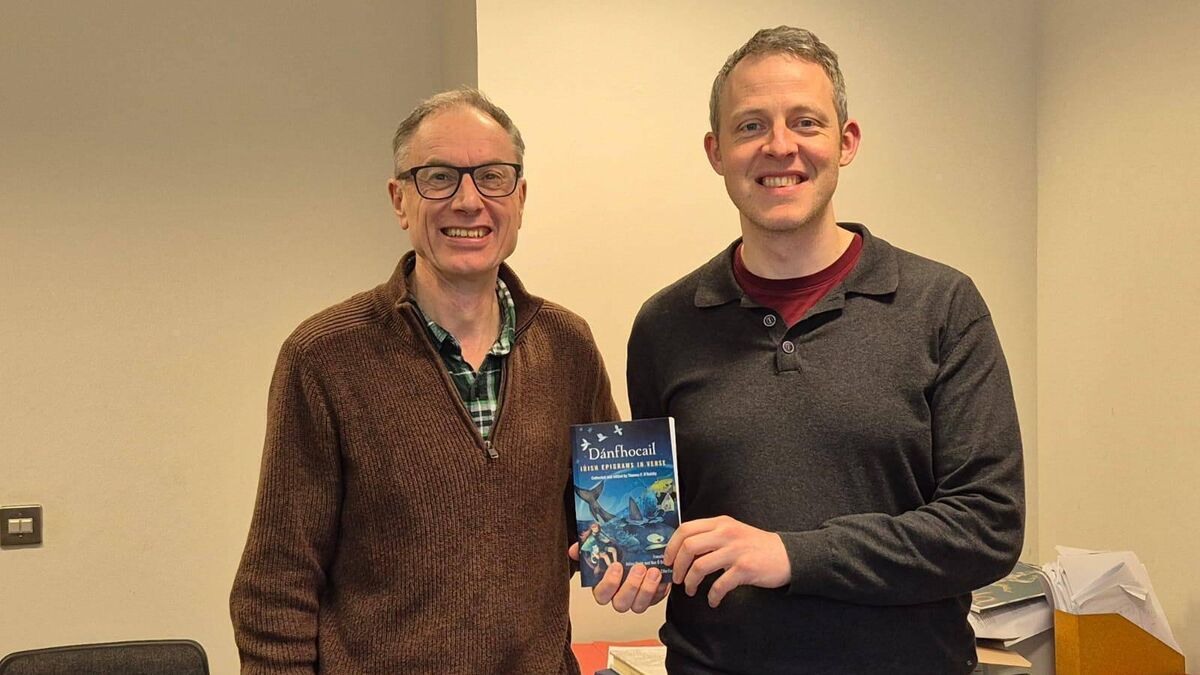
Aidan Doyle and Ken Ó Donnchú, lecturers at UCC, with their book, Dánfhocail: Irish Epigrams In Verse

It took some time for us Irish to get round to realising that our native language was not something to be abhorred, resented, and avoided at all costs.
Many are only now beginning to value it, to see the importance of the way we spoke, wrote, and created masterpieces over the millennia, before being bullied into believing that it was shameful, and should be forgotten.

One of the first actions of the new Irish government of the 1920s was to make a firm effort to reverse that process, to bring back our own speech to our own people.

On July 3, 1924, the then Minister for Education, Eoin MacNeill, announced that the teaching of Irish was to be made compulsory in all schools.

And so, almost inevitably, several generations grew up with a grudge against this forcible inculcation - especially as you were unlikely to pass your exams, even with flying colours in other subjects, if you didn’t get good marks in Irish.

Dánfhocail: Irish Epigrams In Verse. Collected and edited by T. F. O’Rahilly in 1921, which is published by Cork University Press

Not everybody begrudged it, of course - there were still schools where our own language took precedence, and in Gaeltacht areas it had never really left.

But for the majority of the population, it was an unwelcome load to shoulder on top of the usual challenges of education.

Now, happily, that is changing. The signs are everywhere.

We are gradually coming to realise that to know your own language, to be able to speak even a few words, is to have acknowledged your cultural heritage, to show pride in our country’s history.

A land without its own language is a land without a soul, as Padraig Pearse said.

Back in 1921, the legendary Irish linguist T. F. O’Rahilly decided it would be a good idea to collect many of the old sayings and catchphrases from rare surviving manuscripts.

He felt it was quite enough to get them together and between the covers of a book. To translate them into English did not appear necessary or even desirable.

That he did such work, while these sources were still available, is of huge importance.

His work has since become well known among scholars, in the groves of academe, familiar to those studying our ancient language.

Today, however, you need to do rather more to ensure that our ancient writings can reach a wider audience, not just here in Ireland but abroad too.

To limit the work only to those who can read the earlier and often difficult renderings of Irish, is to put too much of a fence around it. It makes sense to offer translations, so that so many more can enjoy discovering what our forefathers said and thought.

And that was where Aidan Doyle and Ken Ó Donnchú came in, with the proposal to translate and update O’Rahilly’s seminal work, to put it into modern Irish and also into English.

The result is Dánfhocail: Irish Epigrams In Verse. Collected and edited by T. F. O’Rahilly in 1921, published by Cork University Press.

It was certainly not an easy task that Doyle and Ó Donnchú - lecturers in the Department of Modern Irish in University College Cork - undertook. Almost 300 poems are featured in their book.

Translating from one language to another is notoriously difficult, and even more so when you are dealing with the poetic, rhythmic cadences of Irish and endeavouring to give the same effect in the more prosaic English tongue.

That they have succeeded so well is nothing short of amazing, and they are to be applauded for bringing the very voices of the past to the wider reading public of our modern world, where they might otherwise never have been heard.

In our long-delayed but eventual realisation that our own native language is not something to be avoided or despised, but rather to be grasped, delighted in, used on every occasion in the widest possible sphere, Dánfhocail comes at a very opportune time.

Now we can enjoy the wit and wisdom of our ancestors, which in turn drew on the priceless memories of millennia when Ireland was indeed an island of scholars and learning.

The epigrams or sayings of old Ireland are generally witty, short observances on the best, the worst, the happiest, the most frequent occurrences in everyday life.

As such, they are a priceless insight into the world of our forefathers and the matters that occupied their minds. That alone is worth a great deal to researchers.

And for the general reader, with the Irish conveniently placed on one page, and the English translation on the facing one, you can lose yourself in the past, while at the same time improving your ‘cupla focail’ beyond belief!

Usefully grouped under headings of Generosity And Miserliness; Poverty And Wealth; Speech And Silence; Women And Love; Youth And Old Age, etc, you can dip into them at any time and find something that makes you smile or nod thoughtfully:

Honey and a woman, sweet milk and a child,

Food and a generous person, meat and a cat,

A craftsman in the house and an edged tool,

It’s very dangerous to put these together.

Or

The advice of a friend I give to you,

And as long as you live, do as I say;

No matter how lovely her face, don’t marry a woman

Until you first get to know her mind.

And, of course:

God’s curse be forever

On the vile small glass

And worse than that is the hand

That didn’t put half enough in it!

This is a little book that should be by everybody’s bedside. Ideally timed for this welcome renewal of interest in our own language, grab your own copy.

Dánfhocail: Irish Epigrams In Verse. Collected and edited by T. F. O’Rahilly In 1921; translated and republished by Aidan Doyle and Ken Ó Donnchú in 2026. Cork University Press. ISBN 978-1-78205-090-2. Available from all good bookshops.
More in this section

Cork family thanks community for support: ‘So much changed..We’re grateful Matthew is alive’ Cork family thanks community for support: ‘So much changed..We’re grateful Matthew is alive’
Dave, 86, in final preparations for his fifth Cork City marathon in a row Dave, 86, in final preparations for his fifth Cork City marathon in a row
Person to Person: How would I like to be remembered?...as Feis Maitiu winner 1994  Person to Person: How would I like to be remembered?...as Feis Maitiu winner 1994 

Sponsored Content

Gas Networks Ireland, committed to conserving and enhancing biodiversity Gas Networks Ireland, committed to conserving and enhancing biodiversity
 EirGrid, ensuring nature thrives in journey to cleaner energy future EirGrid, ensuring nature thrives in journey to cleaner energy future
The future is flexible for cleaner energy use in business The future is flexible for cleaner energy use in business
Contact Us Cookie Policy Privacy Policy Terms and Conditions

© Examiner Echo Group Limited

Add Echolive.ie to your home screen - easy access to Cork news, views, sport and more