Alan Stivell returns to play in Cork after almost 50 years 
As he prepares to return to Cork city to perform almost 50 years after his last appearance here, French Celtic musician Alan Stivell tells COLETTE SHERIDAN about his many collaborations, and his connection to Breton and Celtic culture
Alan Stivell returns to play in Cork after almost 50 years 

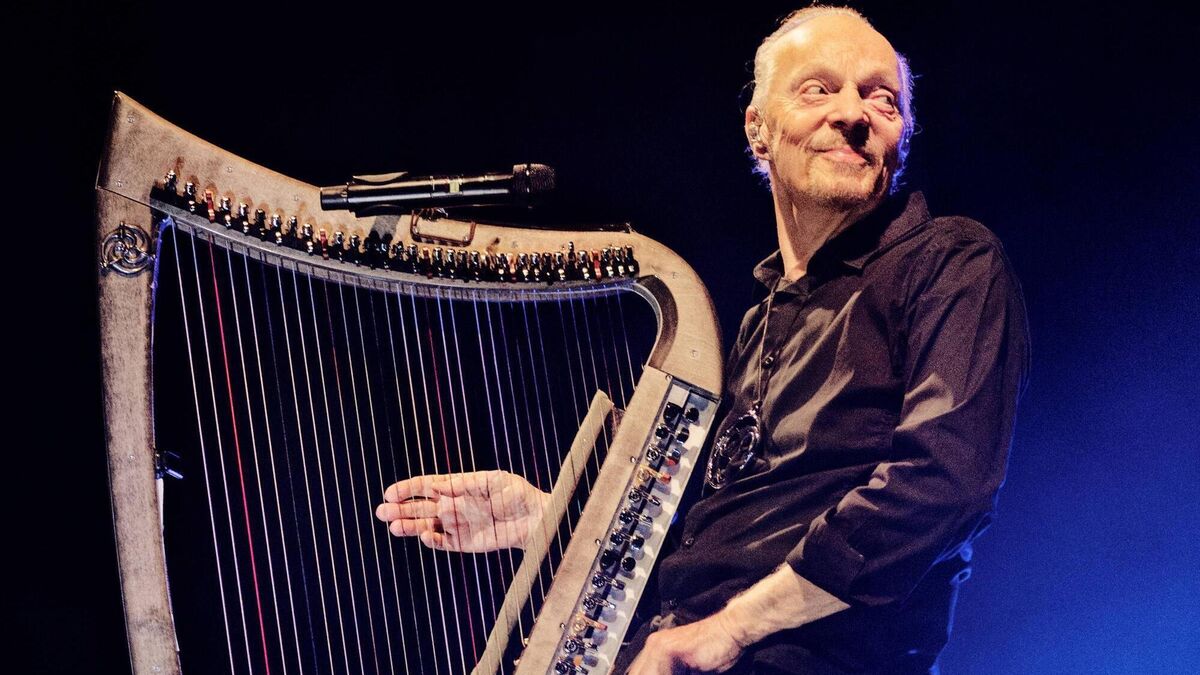
Alan Stivell who will be performing a concert in Cork on May 27. Picture: Maxime Duhamel

French Celtic musician and master of the Breton Celtic harp, Alan Stivell, is coming to Cork to play at St Luke’s, having last performed in the city at Siamsa Cois Laoi in 1978.

Back then, Alan was the headline act at a concert that featured The Dubliners, The Wolfe Tones, The Chieftains, and fiddle player, Paddy Glackin.

While Alan, 82, has played in Dublin several times since, he is looking forward to returning to Cork where he recalls a lot of “warmth” for his music.

“I was very well received in Cork. It was fantastic for me because I’m so much in love with Ireland and the culture,” says Alan, who has topped the charts in France on occasion, over a lengthy career.

He says he is best known for his album, Renaissance Of The Celtic Harp.

Alan was born in Riom in central France. His Breton father, Georges Cochevelou, was a civil servant who achieved his dream of recreating a Celtic or Breton harp.

“The idea was to make a harp like a Stradivarius violin with a fantastic sound and visually great,” explains Alan.

“Everybody would fall in love with the sound and the harp itself. When that happened, it was extraordinary and beautiful.”

Alan, whose surname is his stage name, meaning ‘fountain’ in Breton, was brought up in Paris and kept in touch with the Breton diaspora.

At the age of nine, he started to play the harp fashioned by his father with strings suitable for a child’s hands.

“By 1963, I was performing on the stage, playing mainly for the Breton community in Paris. Many of them became fans of the Celtic harp which was revived.”

Alan, who met the recently deceased Irish harpist Moya Brennan and admired her playing, says that all his life, he has been working with technology, “extending the music of the harp”.

He adds: “I was a fan of science fiction when I was a child. I was reading Celtic mythology. I felt there was something as fantastic as Irish Celtic mythology and science fiction. I was very enthusiastic.”

Deeply absorbed in Breton and other Celtic traditions, Alan learned the Breton language as well as traditional Breton dance, the Scottish bagpipes and the Bombarde, a traditional Breton instrument from the oboe family.

He also learned the drums, the Irish flute, and tin whistle, and won a number of Breton traditional music competitions in the Bleimor Pipe Band.

While he was exposed to cosmopolitan influences in Paris, he spent much of his teens in Brittany.

As a young man, Alan liked electric guitar and rock’n’roll in France and other parts of Europe. That was an influence on his work.

While he was initially trained in classical music, his idea was to mix rock and Celtic music. He cites the Irish band, Horslips, as having successfully melded the two musical genres.

With a new bardic harp with bronze strings, Alan experimented with Celtic rock. In 1966, he began to perform and record as a singer.

The following year, he was signed by Philips Records. This was during the emergence of the New Breton and Celtic music.

In 1968, having toured and made regular appearances at the American Centre in Paris, Alan joined the Moody Blues on stage, performing in London’s Queen Elizabeth Hall.

In 1970, Alan had a hit single ( Broceliande) and a hit album ( Reflets). He became closely involved with the burgeoning Breton roots revival, particularly after the release of the purely instrumental album, Renaissance Of The Celtic Harp, in 1971. It won one of the most prestigious awards in France, the Académie Charles Cros.

What made Alan well-known throughout France was his performance in 1972 at the Olympia Theatre in Paris.

He and his band played music combining traditional Celtic music with modern sounds (electric guitar, drums). Despite this eclectic approach to music being considered risky, it took off and more than one and a half million records made of that concert at the Olympia were sold.

Alan went on to tour France, the UK, the US, and Canada.

He continued recording and published a collection of Breton poetry. His Symphonie Celtique mixed, for the first time, elements of rock, a symphonic orchestra, Celtic instruments, and non-European ethnic sounds.

While the folk music revival was on the wane in the 1980s, Alan maintained a popular following. He continued to tour around the world and recorded music. He also worked with Kate Bush.

Alan recalls performing with Shane MacGowan in London in 1993. “He sang two songs with me. He came to Brittany to record some songs,” he recalled.

“We did The Foggy Dew together and two Breton songs. He was very interesting with his different approach to music.”

Among the other musicians Alan worked with on his international album, 1 Douar/(1 Earth) were Paddy Moloney (of The Chieftains), Jim Kerr (of Simple Minds), Khaled and Youssou N’Dour.

Alan has gone on to record other albums that were well received. He says the French and most Bretons were “very much against Breton culture,” adding: “It’s a long story.

“At school, French governments tried to make Bretons ashamed of their language. It was forbidden. It’s very complex. But the revival happened.”

Alan can take pride in contributing substantially to that revival.

He has no plans to retire. Ignited by passion, he has made a life out of traditional music mixed with other elements, appealing to fans of new age music as well as fans of Celtic music and English folk music.

Alan Stivell plays St Luke’s in Cork on May 27. Also, he will perform at St Nicholas’ Collegiate Church in Galway on May 26 and The Ambassador in Dublin on May 25.
More in this section

Falcons make home atop Cork cathedral Falcons make home atop Cork cathedral
TV: Cork's Kyla Cobbler takes on daunting climb in Uncharted TV: Cork's Kyla Cobbler takes on daunting climb in Uncharted
TV: Gaza music man brings vibe to Cork TV: Gaza music man brings vibe to Cork

Sponsored Content

Gas Networks Ireland, committed to conserving and enhancing biodiversity Gas Networks Ireland, committed to conserving and enhancing biodiversity
 EirGrid, ensuring nature thrives in journey to cleaner energy future EirGrid, ensuring nature thrives in journey to cleaner energy future
The future is flexible for cleaner energy use in business The future is flexible for cleaner energy use in business
Contact Us Cookie Policy Privacy Policy Terms and Conditions

© Examiner Echo Group Limited

Add Echolive.ie to your home screen - easy access to Cork news, views, sport and more