Years of the 5: 100th anniversary of first Fastnet Yacht Race

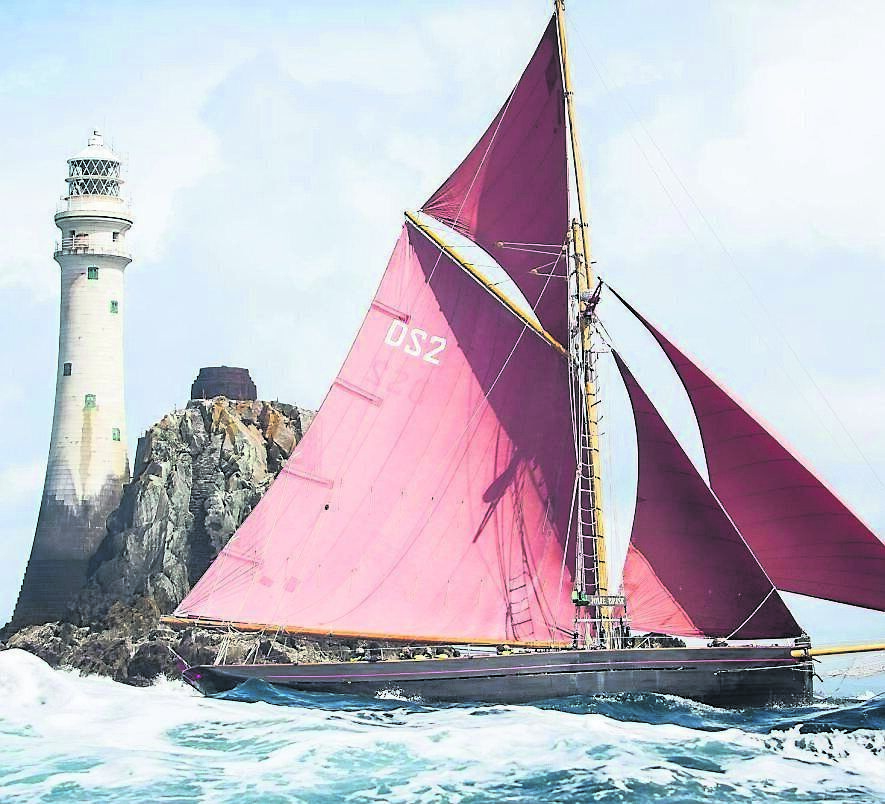
Jolie Brise passing the Fastnet Rock. She won the Fastnet Race in 1925. Picture: Brian Carlin
There is one aspect of the Fastnet Yacht Race which the UK Royal Ocean Racing Club that organises it has no hope of changing.
It has, over the century-long history of the race, changed the start location, changed where the race is finished, and modified the course, but the Fastnet Rock itself remains the signifying race fixture.
Globally recognised, Fastnet is a classic lighthouse, 54-metres high (177ft), the most southerly point of Ireland, four nautical miles south/west of Cape Clear Island, and the nearest point of the Irish mainland.
Harry Donegan’s 17-ton all-gaff cutter Gull from Cork came third overall in the first Fastnet race of 1925, which started from the Royal Victoria Yacht Club in Fishbourne, West Sussex.
He would become a founder member of the Royal Ocean Racing Club, which emerged from that first race and, a few years later, of the famous Irish Cruising Club, the inaugural meeting of which was held in at Glengarriff on the head of Bantry Bay on Saturday, July 13, 1929, four years after that inaugural Fastnet Race. His family later maintained connections with the Fastnet Race.
The first Fastnet Race was known as the ‘Ocean Race’ and is now regarded as having started interest in offshore racing on the western side the Atlantic. Not everyone was in favour. Cruising was then the dominant aspect of sailing. The issue was raised of whether offshore racing might be at the expense of good seamanship.
Weston Martyr, a former English seaman and then a yachting journalist based in New York, wrote an article in the leading UK sailing magazine Yachting Monthly - which still publishes - challenging British yachtsmen to stage an ocean race in British waters: “It is without question the very finest sport that a man can possibly engage in. To play this game at all, it is necessary to possess in the very highest degree those hallmarks of a true sportsman - skill, courage and endurance.”
Then Yachting Monthly Editor Malden Heckstall-Smith and Lt Commander EG Martin, a life-long yachtsman with a keen interest in Working Boats, who had successfully raced 6-metre yachts, and was Rear Commodore of the Royal Western Yacht Club and a member of the Royal Cruising Club, took up Martyr’s challenge and formed, with him, the original Ocean Race Committee.
Olympian Algernon Maudslay and other influential sailing figures of the time in the UK - Sir Ralph Gore and the King’s Sailing Master Sir Philip Hunloke - became involved in choosing a ‘classic’ course for the first race.
It would be from the Solent to Fastnet Rock, finishing in Plymouth, and open to “any fully decked yacht of any rig with a waterline length of 30-50ft, in cruising trim and carrying a lifeboat”.
Vessels would be measured according to a modified version of the Boat Racing Association’s system to create an offshore rating. Martin donated the Challenge Cup, which remains the overall IRC handicap prize to this day.
The first race began on Saturday, August 15, 1925, at noon, from the Royal Victoria Yacht Club in Fishbourne; 16 boats had been entered, but just seven started. Martin’s Jolie Brise, built in Le Havre, France, in 1913 was the longest at 55ft, No purpose-built offshore racing yachts then existed.
From the start, out into the Celtic Sea, Jolie Brise and Gull were locked in a race for the lead. Jolie Brise was first around the Fastnet Rock at 7.50pm on the Wednesday, followed by Gull at 8.35am the next morning. The race took six days, two hours and was won by Jolie Brise in the first of three victories.
At the prize-giving dinner after the race, in the Royal Western Yacht Club up on Plymouth Hoe, competitors and stakeholders formally founded the Ocean Racing Club which has since staged the race. Lt Cmdr Martin was elected the first Commodore.
The 1913-built Le Havre pilot cutter, Jolie Brise, is still sailing, “looking better than ever,” according to a recent description.
Since then, the Fastnet has become a race of 450 boats, with a limit that is reached for every race within a few hours of the opening of entries. Yachts and competitors now reflect the modern changes in society and technology.
“For many in the world’s international offshore racing community, the Fastnet Rock is all they know of Ireland,” says leading Irish yachting writer, W.M. Nixon, who sailed in the Golden Jubilee Fastnet Race in 1975.
The 1979 race was hit by a storm: 24 yachts were abandoned, five sank, 136 sailors were rescued. The largest-ever sea rescue operation off the Irish coast involved RNLI lifeboats, the Naval Service. RAF and Royal Navy helicopters, as Ireland did not have its own at the time. Ships were called to the rescue, including the car ferry Saint Killian en route from Le Havre to Rosslare, which changed course to help the search.
Competing boats were scattered over a vast area. 18 people, 15 competing yachtsmen, and three rescuers, died. A total of 86 yachts finished. Many took refuge in Irish ports. One Irish hope in the race, Regardless, sought shelter in Baltimore.
Hugh Coveney, father of former Tánaiste Simon Coveney and later Marine Minister, was Skipper of Golden Apple from Cork, one of the 303 yachts racing. Its rudder broke off 30 miles north-west of the Scilly Isles in the middle of the storm. Ron Holland, the yacht’s designer, was aboard. The crew took to their life-raft; one of them, international sailor Harold Cudmore left a note on the yacht’s chart table: ‘Gone for lunch, be back in a while’. They were rescued by a Royal Naval helicopter.
Overall, Irish yachts have done well in the race. Cork boats and sailors have always been part of it.
“After great promise leading into the stormy 1979 Fastnet, it was Donal McClement of Cork with the UFO 34 Black Arrow, who had a Class win,” recalls W.M. Nixon.
“In 1981, Ken Rohan’s Holland 40 Regardless won Class 1, with Tim Goodbody lead helm on the overall winning Dubois 40 Irish Independent in 1987, followed by the peak of peaks, Ger O’Rourke of Limerick and Kilrush, spectacularly winning overall in 2007 with his hyper-successful Cookson 50 Chieftain, still arguably the greatest Irish sailing achievement of the 21st century.”
Denis Doyle’s Frers 51 Moonduster was an admired feature of the European offshore racing scene and the Fastnet Race for many years. He sailed his last Fastnet Race aged 81 and died in 2001, not long after completing that race.
In 1977, the Ron Holland-designed Imp stamped her mark on the Fastnet Race. She is now owned by the Radley family of Cobh and has had several racing successes, including in the Round Ireland.
The centenary of the Rolex Fastnet Race will start on July 26, 2025, from Cowes in the Isle of Wight, and finish, for a third time, in Cherbourg-en-Cotentin, France, a course of 695 nautical miles.






 App?
App?


