Willow talk... a great plant for winter gardens

A giant snail sculpted from willow rods
IT seems to me that January has passed by very quickly this year, most unusual and probably in part due to the relatively settled weather that has prevailed.
The considerably dry month has enabled work to progress nicely for the start of 2022, with plenty of pruning underway - and weeding, tidying and edging of beds can be undertaken also as the ground conditions are favourable.
There have even been echoes of engines running as shaggy winter lawns are evened out with a high cut on the lawnmower. It may be tempting to lower the blades but resist, as cutting the grass too tightly will encourage moss growth at the expense of the grass.
During the winter months, there is much to admire in the gardens and one plant that goes largely unnoticed during the summer and becomes a focal point now is willow, particularly the brightly coloured stemmed cultivars. Different willows offer different characteristics, some have colourful stems, some have amazing catkins in springtime laden with pollen and nectar, some have particularly pliable stems suited for making garden sculptures, supports and baskets, and some will create specimen trees in the garden.
There is a willow suited for every garden, no matter how naturalised or manicured the style, that is for sure, and what a great plant for wildlife, aesthetics over the leaner winter months and to occupy a damper spot in the garden.
Creating a living sculpture from the stems coppiced the previous year can create winter interest and is a great use of the living stems within the garden. Looping the stems down and tying them in at the base of the coppiced plant can create looped petal and flower effects when the leaves die back over winter, as they have done in Hyde Hall RHS garden.
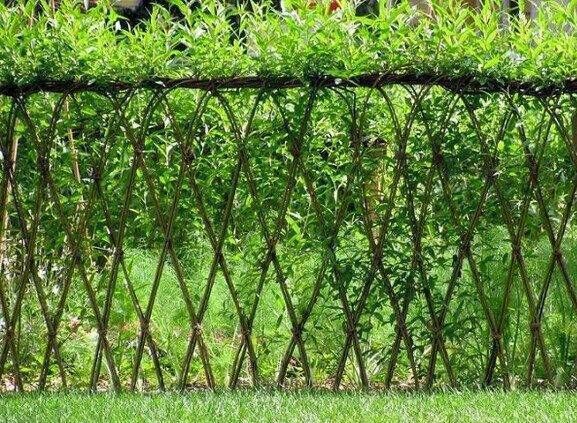
Living fences or fedges (a cross between a hedge and a fence) can make attractive and speedy screens, separating different areas of the garden and also creating wildlife corridors. Sculpture pieces can be created from the cut rods also, the natural materials look great set among plants and trees in the garden, with hares, snails, birds and deer some of the subjects created with this flexible plant material.
Willow is such a versatile plant and roots readily, particularly liking an open sunny site with a free draining but water retentive soil, and they like a high water table.
From now until March is a good time to get planting and putting cuttings into the ground. If willow stems are cut and put into a bucket of water for a few weeks, they will form roots quickly, and now is the time to do it, while the plants are dormant and before the sap rises.
There are many types of willow and some are more suited to willow weaving than others as their stems are more pliable and grow straighter.
The golden willow (Salix alba var. vitellinia) is noted for its colourful stems, most striking during winter months. Purple willow or purple osier (Salix purpurea) has pliable stems, making it a great willow for weaving. Black maul or almond leaved willow (Salix triandra) produces strong pliable stems excellent for use in basket making and weaving and is one of the most commonly used willows in this industry.
These three willows are the most popular for use in willow weaving and are good ones to start growing if you’re interested in producing rods for weaving. Usually the plants are coppiced annually, with the rods harvested during the dormant season.
There are other, more ornamental willows to consider for the garden. The corkscrew willow or Salix matsudana ‘Tortuosa’ is an upright tree with contorted branches a bit like the contorted hazel. The stems can be coppiced annually or biannually to maintain the young contorted branches and control the size in a smaller garden. The young branches are useful for flower arranging and this plant looks great in the garden during the winter months.
Salix alba ‘Britzensis’ has striking orange/red stems in winter, producing quite the display when mass planted along a boundary or at the back of a border. Salix babylonica or the weeping willow is one of the best known and loved willow trees. Associated with growing adjacent to rivers with its graceful weeping branches sweeping into the waters edge, this romantic, graceful tree the requires a good amount of space to reach its full height and spread so choose the planting location carefully.
Salix caprea, goat willow or pussy willow, is a native found growing in hedgerows across Ireland, providing an early source of pollen and nectar for bees and early flying pollinators.
Salix gracilistyla ‘Mount Aso’ is a compact willow producing fluffy pink catkins early in the year.
One of the most important factors to consider when planting willows is to keep them a good distance from buildings and services like sewer pipes in the ground, as their roots naturally look for water and can damage underground pipes and building foundations.
When incorporating a living willow feature into the garden like a fedge, sculpture or archway, be aware that annual maintenance will be necessary to keep these features looking good and that willow grows at a fast rate. Happy Planting and Planning!






 App?
App?


