Welcome to the 2025 Holly Bough
The 2025 Holly Bough is now on sale!
A very happy Christmas and a warm welcome to the 2025 Holly Bough.
Over the past 12 months, we have heard from people right across the world with tales to share for this year’s edition.
Inside, you’ll find a real feast of stories to entertain, inform, give you a giggle, and in some cases bring a tear to your eye.
Shane Lehane takes us on a trip back to see Santy in Cork city, while Ed Finn tells us about his school tour where he and his classmates met the Pope!
We hear about pilgrimages, island life, sending turkeys on planes, and friendships.
Three Corkonians living abroad share their memories of Christmas and tell us how they celebrate each year.
Former Eurovision star, Cathal Dunne leads our short story and fiction section this year with an extract from his new book. The wonderful artwork in the fiction section was created by the students at Bandon Grammar School.

There’s plenty of sport, entertainment, arts, history and lifestyle too.
You’ll find our Junior Holly Bough in the middle of this issue- with plenty of puzzles and our colouring competition for our youngest readers.
All the usual favourites are inside too-the Diffney, the film quiz, the Humdinger, and our crossword.
In our obituaries, we remember those who have left us in the past year.
For many, the arrival of the Holly Bough has come to signal the beginning of the countdown to Christmas, and we are delighted to be a part of your preparations for the festive period.
From all of us here at the Holly Bough, we wish you and all yours, a very happy Christmas and best wishes for 2026.

Mary Corcoran
Editor of Holly Bough
Meet the 2025 Holly Bough cover artist

Holly Bough front page artist Sue Nelson with her artwork and Holly Bough editor Mart Corcoran. Picture: Jim Coughlan
Cork artist and photographer, Sue Nelson created the cover art for this year’s Holly Bough. She spoke to Mary Corcoran about taking a career leap and the inspiration behind the artwork.
For Cork artist Sue Nelson, capturing the stories of people and their connection to place is something which she feels genuinely honoured to play a part in.
A photographer and visual artist, Sue’s artworks often tell the story of places where memories were made.
In fact, Sue says some of the moments that make her work feel most worthwhile are those where she has witnessed how a piece has connected with a person.
“They say, oh, that’s where my husband and I got engaged. We drove down to Kinsale on a motorbike, we had a pint and a packet of crisps, and that was the location of our first date, and that present then was bought as a 30th wedding anniversary gift...They’re the moments that I absolutely love.”
Sue’s cover artwork for this year’s Holly Bough features a familiar cityscape- a view of the city’s docklands and the Port of Cork.
It is one which will resonate with many people who left Cork, who moved here, or who returned home.
“The piece is called Lighting the Way Home and that’s exactly it. It was inspired by the Cork Docklands. The docklands and the Port of Cork have such a significant place in our city’s history and hold so much of our heritage and our stories.”
The piece captures the twinkling lights of the city on the horizon.
“It really is highlighting that mix of new and old Cork now, where the docklands are changing so dramatically... It’s still a real part of the city that holds so much of our heritage,” Sue added.
With a background in engineering, Sue says she loves spending time in the docklands.
“I find it really inspirational. I love that wonderful mix between industry and people’s lives and the stories around the city and how they fit together and knit together,” she says.
It was only in recent years that the Cork woman decided to pursue a career as an artist.
“I started off very much in a traditional background, and I studied science in college and I did a postgrad in science. Then I spent the next 20 years working in engineering, and it was a very traditional 9 to 5 job. I met some wonderful people along the way. I had fantastic experiences, but it was really during covid that I realised I wasn’t where I was supposed to be...That creative side of me was always in the background.. I dipped in and out of painting. It was never prioritised, it was never something that I put any importance on,” Sue said.
It was at this time that Sue decided to change career paths.
“As I said, it was really during covid that I realised I wasn’t where I was supposed to be...I needed to build a more creative life and a more artistic life for myself and tap into those creative talents that I knew were always there underneath the surface.”
Sue admits that deciding to build a creative life, and actually being able to build a sustainable business are very different things.
“Building a business was a massive learning curve. So just because I made the decision wasn’t necessarily that it was going to be successful. I realised pretty early on I needed to learn an awful lot, not just about art and photography, but also about business,” she added.
The risk paid off, and while Sue admits there are moments that she wonders if a career as an artist is too challenging, she has had plenty of moments of success too. Her works have been gifted to visiting dignitaries, she has created an exclusive collection of artwork for Adare Manor, and has an exhibition at Cork’s City Hall in November.
A mixed-method artist, Sue considers herself a visual artist and a photographer.
“My photography I call it graphic photography, but it’s rooted in traditional photography. So the process starts off with me taking a photograph and then using digital illustrations and software, I layer and layer and layer different elements and moments onto the photograph, and then you use digital design to turn it into something almost like a painting in its own right,” she explains.
This process was something that she embraced when creating the cover art.
That piece started off as a picture of a fishing boat in the docklands, moored up on the pier.
“I highlighted both the Port of Cork, and those twinkling lights on the horizon... It starts off as a photograph, but it turns into something that is beautiful,” she adds.
Sue is not actually the first member of her family to appear in the Holly Bough.
“I was talking to my in-laws, and my husband’s grandfather was in the featured in the Holly Bough before the Second World War. My grandmother, I think, was in it. She had her own business in Cork City for over 20 years (a hair salon on Oliver Plunkett St) and mum worked for her,” she said.
Just like her artwork, Sue says that for her, the stories like these are “all about that connection with people and place and old and new”.
Paying a visit to Santy in Cork city

Nora, Margaret Dan and Pat White, Summerhill, Cork queue to meet Santa and receive presents, at Munster Arcade.
For generations, children have visited Santa and his helpers in Cork city, and beyond, in the run up to Christmas. SHANE LEHANE looks back at the start of this tradition and provides a snapshot into the Santa visits of times gone by.
The best present I ever got from Santa in town was a small, silver, battery-operated torch. When you pressed the little orange button on top, it would flash a bright beam of light, and in the absence of night-time, half the day was spent playing with it under the stairs in make-believe darkness.
At that age, reconciling the blatant contradictions and irreconcilable ambiguities that separated the real Santa Claus that came on Christmas Eve and the shop Santa that you visited in the Munster Arcade on Pana, or Buckleys on Academy Street, was no issue whatsoever.
When it came to the latter, pure excitement and the prospect of a present quelled any deep enquiry, and the outing just became part of the Christmas festive enjoyment.
On November 15, 1965, one of the great old Cork shops, Kilgrews, then on Merchant’s Quay, placed an ad in the ‘Situations Vacant’ section of the Cork Examiner that reads as follows: ‘Man required as Santa Claus in toy department, preferably middle-aged; sober habits. State age, letter only.’ This highlights some of the necessary attributes needed to be a good Santa.
However, many a shop Santa left a lot to be desired and tested our abilities to suspend disbelief. A potential Santa who was too young and too thin did little to help the cause, and being portly and rotund filling out the suit was a distinct advantage.
As children, we took notice of the fine detail in assessing his authenticity. We looked at his belt to see if it was real leather with a buckle or just some flimsy fake fabrication. We glanced at his boots - invariably black wellingtons – but we were especially focused on the depth and quality of the white fur trim that set off his red suit. The latter was often badly faded, and the former simply not plush or luxuriant enough to make him out to be the genuine article.
Above all else, we judged shop Santa on the fullness of his white beard and how real it looked. An ill-fitting one was a pure give-away. The position of the moustache over his mouth and how he and his beard were one was essential. To our disappointment, some of the overworked and overheated Santas used to pull their beard down under their chin or leave it hanging from one ear.
Moreover, some Santas, incongruously, were wearing dark sunglasses, and with Kilgrews’ advert ‘sober habits’ in mind, it has to be noted that a few of the portly Santas’ breaths regularly gave off the sweet smell of whiskey and porter. Who could blame these men, given the nature of the job contending from one end of the day to the other with an endless parade of children spanning from the shy and terrified to the obnoxious and precocious?
The earliest account of Santa Claus distributing presents to children in a department store in Cork dates to November, 1926, when Robertson, Ledlie, Ferguson’s department store, The Munster Arcade, advertised that ‘Father Christmas from his Villa Residence distributes to boys and girls suitable toys at a cost of 1’- each’. Within a year or two, the other large Cork shops, Grants, The Queen’s Old Castle, and Cash’s, vying for this trade, installed their own ‘toylands’, along with the parcel-gifting Santa. Roches Stores did not start its Santa campaign until the 1950s, while Dowdens, the other large outlet on Patrick Street, never had one. In the late 1920s, the Santa in Grants (beside the Mutton Lane Inn on Patrick’s Street) was installed, ‘promenading the balcony of our Patrick’s Street warehouse’, where, on paying a shilling, children could ‘walk up the steps, ring the bell and out will come Santa Claus with a lovely present’.
The Queens Old Castle established its version, ‘the magic Snow Palace of Santa’s workshop’ and advised that parents, aunts and uncles should bring the children early to get their parcel and wonder at the range of toys.
In the Munster Arcade (now Penneys), one shilling parcels were distributed by Father Christmas from his cosy snow house, made even more special as access was to be gained via ‘the staircase or electric lift’. Many will recall the lift in the Munster Arcade was an adventure in itself. Its two accordion-like, open-latticed gates had to be pulled across and closed firmly before the button was pushed, and with a bump one took off to the top floor.
This Christmas trip to the very top of the building to see Santa has long lived in the memories of many Corkonians. So many have recounted it as one of the stalwart memories of their childhood Christmases. Those visiting in the 1960s remember walking down a long corridor into the dark attic space and while waiting to see Santa, they sat in a small, make-shift cinema, wide-eyed and mesmerised, watching the now forgotten Christmas cartoons, Walt Disney’s Santa’s Workshop (1932) and The Night Before Christmas (1933).
While the children were visiting Santa, their parents were busy buying presents.
A glance at the advertisements promoting suitable toys for children in Cork’s ‘toylands’ and Christmas ‘bazaars’ some 100 years ago encompasses many classics. They include ‘lovely dolls from the tiniest to almost life-size’ in addition to ‘racing cars, model aeroplanes, cowboy outfits, railway engines, cranes, teddy bears, doggies, sleeping babies, pedal cars, books, prams, soldiers and lorries’.
In addition to buying for the children, the adults were also encouraged to buy their own luxuries. In Cash’s and other department stores, the promoted items included ladies’ and gents’ umbrellas, handkerchiefs, wool cardigans, silk dressing gowns, which are noted as ‘a very acceptable present,’ along with brush and comb sets, travelling rugs, railway wraps, trousers stretchers, and ladies’ handbags. Notably, the now obsolete and maligned wearing of animal furs was then at its height. Suitable Christmas presents included new fur ties in skunk and natural fox, bear, stone marten, wolf, and squirrel tail, along with ’elegant fur coats’ in new smart styles in beaver, musquash and coney seal.
By the late 1940s and early 1950s, the inspirational innovation of photography was added to the ‘going to see Santa in town’ experience. Robert Day and Sons on Patrick Street were one of the pioneers of this idea, employing the ‘Movie Snaps’ photographer and declaring ‘a photograph of your child with Santa Claus is a picture of childish charm to be treasured for ever’.
Professional photographers grabbed the new lucrative opening for their trade, and some, such as the Healy brothers, worked in Cash’s, capturing the eternal moment with Santa.
In the mid-1960s, the new instamatic Polaroid camera allowed an immediate ‘no-waiting’ snapshot of the event. By the 1960s and 1970s, other than the big shops, many of the smaller shops and outlets, such as Kilgrews and Murrays on North Main Street, were offering toyland and photos with Santa. Perhaps the most popular was Buckleys in Academy Street, who cornered the market with the novel idea of getting a young fawn and putting him in a cage. They advertised ‘Visit Santa in his cave and see Rudolf – his own live deer’ and without fail, every child in Cork wanted to visit.
My late father Tadg, worked as a commercial artist, and in addition to making cribs at Christmas time, he was the one who painted and decorated the many Santa ‘grottos’. He was always imaginative in bringing something new to the diorama, and during the Apollo Lunar missions of the 1960s and ’70s, he would paint Santa sitting on a rocket on his way to the moon. His numerous backdrops feature in many of the Santa photographs from the 1950s onwards.
Over the years, I have asked my students to share their Santa photographs with me. While the collection has become an eclectic mix of children sometimes confronted with disconcerting Santas, it is more importantly, a record of each of us at a formative period in our lives, specifically at one repeating point in the cycle of the year.
When you visited Santa in town and had your photograph taken with a ‘shop Santa’, you literally have a shared ‘snapshot’ of innocence and suspended disbelief where you are fully absorbed in an eternal moment of magic. A photograph of any one child at Santa is a photograph of each and every one of our visits to Santa: it is a collective, shared, enduring emotive context of memory.
It is this detail of the familiar, the nostalgia of the shared sameness, that fixes our attention and widens our eyes in recognition of where we all once have been.
In our habitual repetition of this timeless, magical Santa experience, we are all one, past, present and future.
Shane Lehane is the course director of Cultural & Heritage Studies at Cork College of Further Education, Tramore Road Campus, and lectures in folklore in UCC. His new book, Old Ways to New Days: The Folklore, Traditions and Everyday Objects that Shaped Ireland, is published by Hachette Books Ireland.
Gallery
Every year, we publish photos of Holly Bough readers posing with the publication all around the world. Here are some of our editor’s favourites from 2025. Email your photo to hollybough@theecho.ie or follow the steps below where it says Submit a photo.

KIRUNA: Finbarr with the Northern Lights behind him in Kiruna, Sweden

GENEVA: Esther Lennon, Glanworth shared a read with Galway man Oisín Redmond from Salthill, just before they spoke about their experiences working on the Children and Young Peoples Assembly on Biodiversity Loss at the United Nations in Geneva at the 5th Forum on Human Rights Democracy and the Rule of Law with the Children's Rights International Network.

GLASHEEN: Pat and his friend Philip enjoy the Holly Bough with a welcome cup of Barry 's tea in Glasheen following a busy morning

Poros: 15 friends who started junior infants in St Patricks school, Gardiners Hill in 1968, and left in 1981...finally got to go on their Leaving Cert Holiday to Poros, Greece in May 2015.

ESTEPONA: Teddy Bear Peter Crowley from Ovens with Cillian and Niall Corkery from Kinsale Road, catching up on the Holly Bough at Menara Beach in Estepona, Spain

IRELAND: Chris Bowles and daughter Abbie Bowles (2 weeks old) Is this the Hollybough's youngest reader

ARIZONA: Dervla and Olivia O'Leary from Goleen reading the Holly Bough at the Grand Canyon

WIRRAL: Paschal Scanlan, aged 95, formally of Brigid Street, Cork City - enjoying his annual copy of the Holly Bough from Wirral, UK

ISLE OF WIGHT: James Curry holding the Holly Bough taken in Shanklin Old Village on the Isle of Wight

GRONINGEN: Muireann, Éabha, and Lúsaí de Faoite at the Grote Markt, Groningen, in the Netherlands

QUEENSLAND: Mick O' Donovan, Syd Maher, and Brian O'Donovan up in Cairns, Queensland celebrating Mick's 60th birthday

SUNSHIE COAST: Conor Walsh, from Sunday's Well, with his wife Michele and son Brian on life guard duty on the beach at molooabo,Sunshine Coast, Queensland, Australia.
000
Thousand readers wordwide
000
Years the Holly Bough is a Cork tradition
000
Pages bursting with photos and stories
No.1
Christmas publication in Cork
Submit a photo or story
If you have a story to submit to the Holly Bough, or a photo for the Holly Bough Picture Gallery, you can do it here
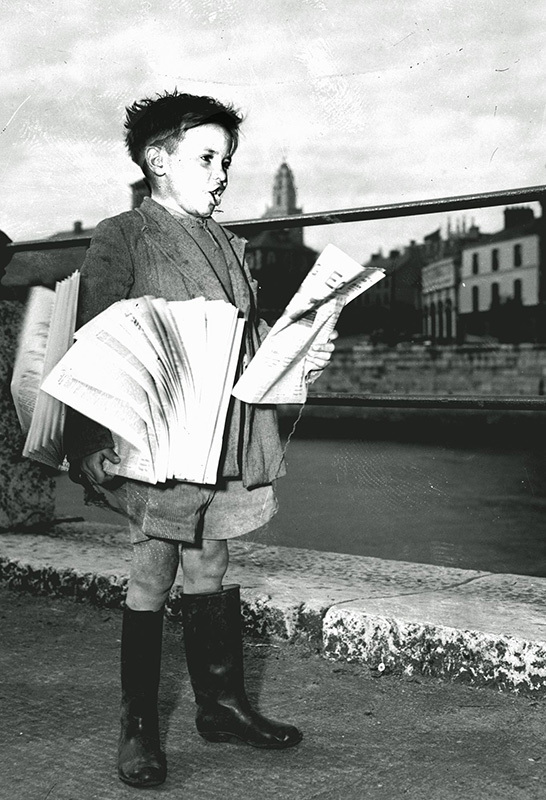
Echo Boy Selling Papers on Lavitts Quay 1953
©The Echo Archive.
Now you can access past editions of Holly Bough online
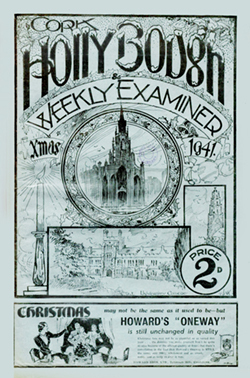
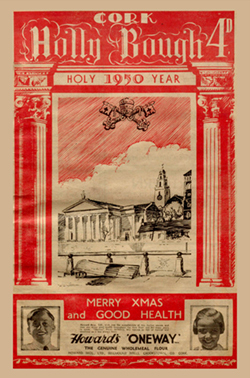
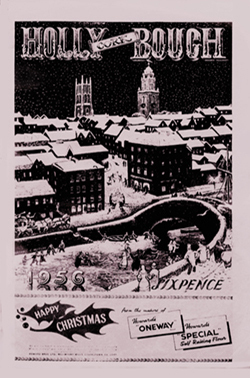
A treasure trove of Cork history lies within the pages of every Holly Bough - and now you can access past editions of Cork’s favourite Christmas publication at the touch of a button.
The publication was digitised and is available to view online on the Irish Newspaper Archives (INA) website - www.irishnewspaperarchives.com Ireland’s largest digital newspaper archive, the website stores hundreds of thousands of pages of past newspapers, including The Echo and Irish Examiner, and provides easy access to more than 300 years of history.
Holly Boughs dating back to 1924 up to the present day can now be viewed online.
Jonathan Martin, of the INA, said: “We are delighted to have the Holly Bough Christmas magazine on board our website. The Holly Bough has been a wonderful Christmas tradition in Cork city and county since 1897.
“The INA believes this title offers a great snap-shot of times gone past, illustrated beautifully in the photos and articles that capture Ireland at its traditionally happiest time of year.
“We hope that you enjoy reading the archive as much as we did digitising them.
“If you have any queries, please don’t hesitate to contact us at info@irishnewspaperarchives.com”
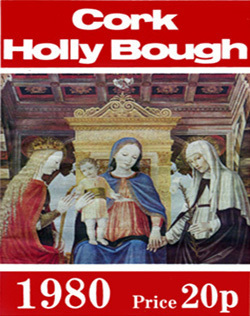
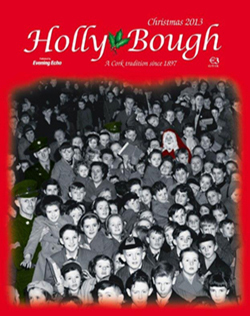

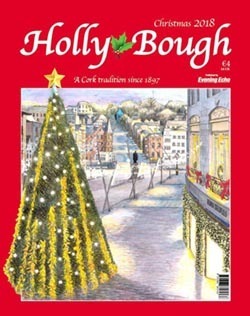
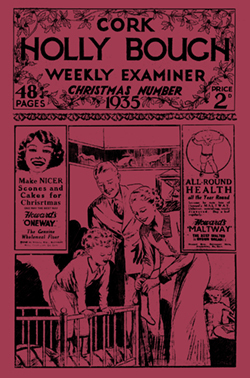
Here, you can view all the Holly Bough covers available on our archives, and from the archives of Cork City Library, from down the ages
"Written by Cork people, for Cork people"
The Holly Bough has been an annual tradition in Cork since 1897.
In that time, it has become a staple of the Christmas season in city and county, and among the diaspora around the world.
It has appeared in all 127 years since it began, apart from a few years during the world wars, and in 1948, when there was a paper shortage. The oldest copy in Cork City Library is from 1924.
The Holly Bough contains a plethora of historical stories and photographs about Cork and its people, as well as festive articles, a food & drink section, a junior section including puzzles, fictional short stories and poems by local people, and a sports section.
The magazine is now larger than it has ever been in its history – 164 pages.
Editors down the years have included Stephen Coughlan, Walter McGrath, John Dolan, and the current editor, Mary Corcoran, took up the role this year.
She attributes the continued success of the publication to the many contributors, writers, editors, photographers, designers, printers and distributors who make the Holly Bough a reality each year and play a vital role in keeping the tradition alive.
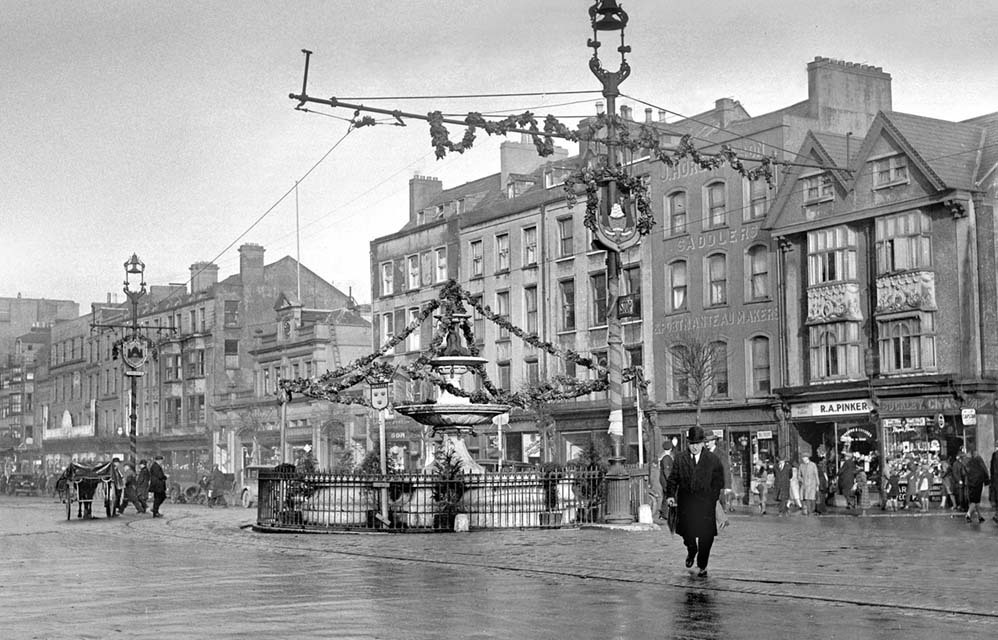
Christmas decorations on Grand Parade. In centre is Berwick Fountain, which was designed by Sir John Benson and paid for by Judge Berwick 15/12/1930 ©The Echo Archive.