Exercise and the brain – how to adapt and boost brainpower!

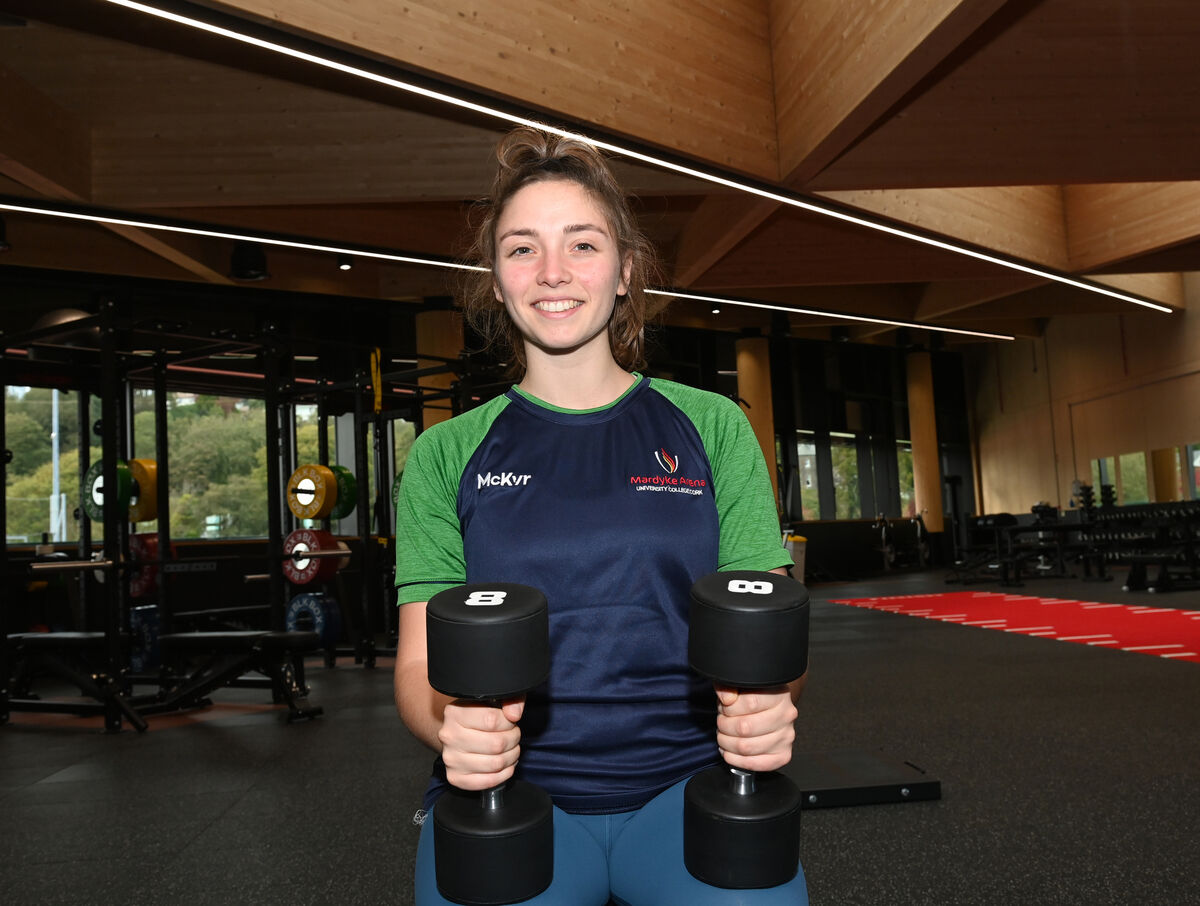
Strength and Conditioning coach....Fitness instructor Kaitlyn O'Callaghan in the squad training gym at Mardyke Arena, University College, Cork. Pic Larry Cummins
MANY students recently returned to college and are adjusting to a new routine with lectures, assignments and dare we mention the imminent exams at the end of the Semester.
College is a time of change and adjustment and this is particularly true for the first-time college students.
It is normal to experience anxiety and fear among the many different emotions you'll feel in the first year.
While your greater sense of freedom may in many ways be a welcome change, it can also be stressful, or bring about confusion, sadness and loneliness.
In a week, where we celebrate World Mental Health Day, we need to consider the role exercise can play in managing common mental health issues that some students may struggle with and the positive effects of exercise on our college experience.
Stress Let’s talk about stress.

College can be a stressful environment for many with personal and academic challenges.
Students face enormous stress in adapting to college life, fitting in with their peers, work overload, and perhaps the emotional toll of missing family and friend.
Exercise controls the emotional and physical feelings of stress, and it also works at the cellular level.
Physical activity is a natural way to prevent the negative consequences of stress because it can ward off the ill effects of chronic stress and actually reverse them.
In addition, studies show people who add physical activity to their lives become more socially active, which boosts confidence and helps establish and maintain social connections.
Anxiety is defined as our body and mind's natural reaction to threat or danger but worrying when there's no real threat, to the point where one can't function normally, is an anxiety disorder.
Most research indicate that aerobic exercise considerably lessens the signs and symptoms of anxiety disorders.
People learn to reduce anxiety and regain confidence through exercising.
You can feel better, sleep better, and relax more if you exercise. It can aid in stress reduction and anxiety release.
Any activity is beneficial, as long as you engage in enough of it and it is appropriate for your skill level.
Consider joining a club, partaking in a course of exercise or regularly making gym / pool visits part of your routine.
This will encourage you to continue doing it every day.
It is well-known that aerobic exercise reduces the symptoms of depression.
According to studies, the endorphins released by exercise in the brain help people feel good overall.
Dopamine is boosted by exercise as well, which elevates mood and sharpens focus.
For students who experience depression, thirty minutes of moderate exercise a few days a week can be life-changing.
Endorphins, the body's feel-good chemicals, are released during high-intensity exercise.
However, for the majority of us, sustained low-intensity exercise has the greatest benefits.
Such activity triggers the production of proteins referred to as neurotrophic or growth factors, which lead to the expansion and development of new connections between nerve cells.
You feel better because your brain is working better.
College can be an especially excruciating environment for students with attention deficit hyperactivity disorder (ADHD) because of the need to sit still, face forward, and listen.
Structured exercise—in the form of martial arts, dance, or gymnastics, for example—is one of the best treatment strategies for ADHD. The combination of challenging both the brain and body is even better than just aerobic activity alone because the technicality of those sports activates brain areas that "control balance, timing, sequencing, evaluating consequences, switching, error correction, fine motor adjustment, inhibition, and, of course, intense focus and concentration."
Strengthened Memory Research shows that physical exercise releases proteins in the brain that can actually help improve your memory and increase your cognitive performance.
This is because the hippocampus, the area of our brain that is involved with retaining information is incredibly responsive to these proteins.
So, whether you’re revising for an exam or listening to a lecture, you’ll be able to take in and retain what you learn much more easily if you have been doing some regular exercise.
When you do any type of intense physical activity, it causes blood to flow to the brain.
This in turn fires up your neurones and promotes cell growth, particularly in the hippocampus.
This means that just 20 minutes of exercise before studying can improve your concentration and help you focus your learning.
Experts have found that there is a connection between being physically healthy and delivering a strong academic performance.
This is because low-intensity exercise can give our energy levels a much-needed boost, which is perfect for when you’re studying long hours.
Studies also prove that exercise boosts creativity and mental energy.
So, if you’re in need of inspiration, your big idea could be just a walk or jog away.
So, exercise will not only flex the muscle of the body but also the muscles of the brian.
Exercise is a simple as going for a walk, cycle or any form of aerobic activity.
For variety you can include a strength training programme, join a club activity or partake in a dance or yoga class.
By partaking in exercise, you can distract your mind from stress related tasks and free yourself mentally.







 App?
App?


