Nostalgia: Trip back in time along the Mardyke Walk
The iconic Band Field was a a popular venue for Corkonians to enjoy public music recitals
Nostalgia: Trip back in time along the Mardyke Walk

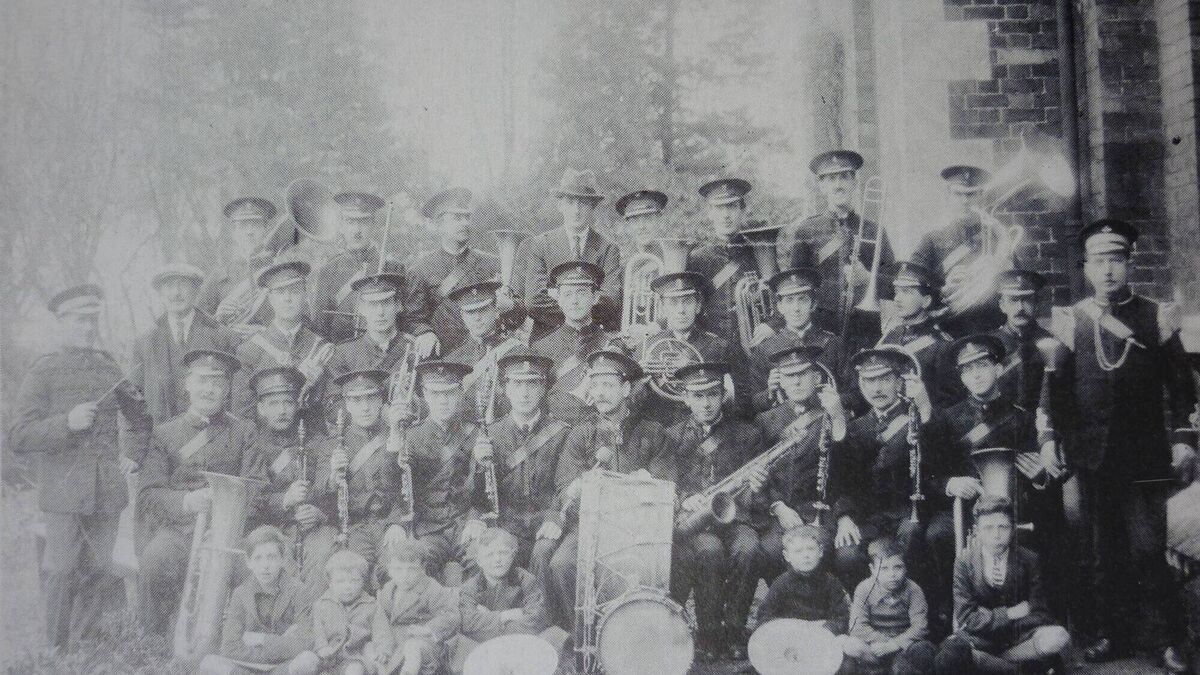
The Barrack Street Band, popularly known as Da Barracka was founded in 1837 in the southside of the city. This 1925 photograph shows their band members in elegant uniform with their young budding enthusiastic members seated in front. Courtesy: The Barrack Street Band

The development of the Mardyke Walk reached its peak in the 1860s and it surely must have been the most beautiful urban as well as city promenade in Ireland.

Evidence of the walk’s beauty is clearly seen in the following statement made by a visitor: It reminds one of a French boulevard, but it is surrounded by scenery that few French boulevards can boast of.

To make the walk more attractive, the Corporation erected an elegant ornamental, wooden bandstand in a field south of the avenue. This was called the Band Field and was located where the present two-lane roadway, which connects Western Road with the Mardyke Walk, is situated today. It was about an acre in size, bounded on the east and west by stone walls and sheltered by stately trees with wooden seats for the convenience of the public. This stretch of ground was destined to become Cork’s most popular haunt for brass band enthusiasts.

Recitals

The season’s outdoor public band recitals began in May and ran to September. Organised by the Committee for Arrangement (a body set up by the corporation to organise public entertainment), these popular events were held at various venues throughout the city - the most popular being the Mardyke, marina, Grand Parade and the Lough. 
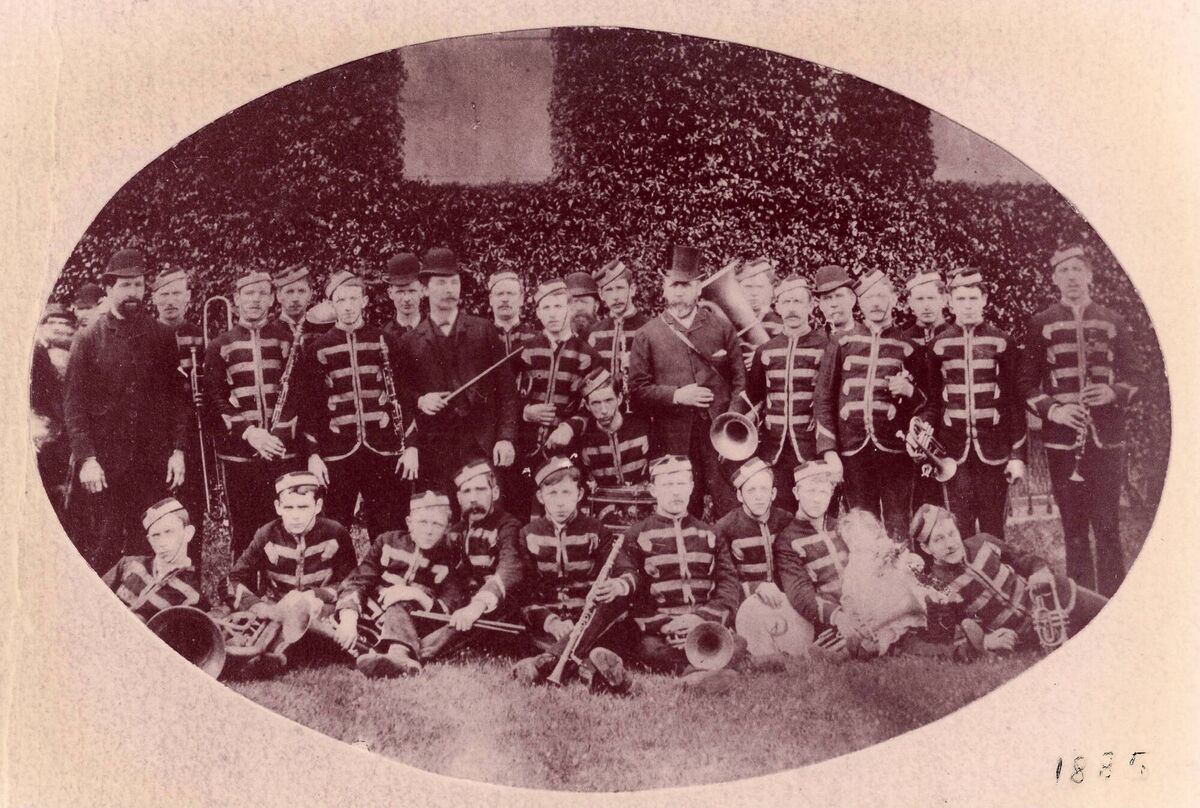
Butter Exchange Band, popularly known as Da Buttera was established in 1878 in the northside of the city. This 1885 photograph shows their members in elegant uniform with committee members. Courtesy: The Butter Exchange Band

The Mardyke, however, was the Corkonians’ favourite venue owing to its scenic beauty, shelter and most important of all, the Band Field which held the sound of the music due to its enclosure. The Dyke recitals took place on Tuesday and Thursday evenings from 7 to 9 o’clock, and on Sunday afternoon. Eventually, evening concerts increased to three a week due to public demand.

Field thronged

During these first-class performances, the Band Field and its surrounds would be thronged with people from all walks of life, the majority of whom were the working classes, listening to their own favourite marches, waltzes or overtures being beautifully rendered by one of the city’s military or civilian brass and reed bands.

Bands lacked discipline

In the early years, the military bands dominated the public recital scene because the citizens could always depend on them to turn up on time and give their performance, unlike some of the civilian bands. During Charles Stewart Parnell’s (1846-1891) campaign for Home Rule, the city had a hive of political, as well as temperance, brass and reed/fife and drum civilian bands. The majority lacked discipline, but bands like the Barrack Street and the Butter Exchange bands, just to mention a few, were well-disciplined and trained in every aspect; and their music ability was as good as any military band of the day.

Many of the civilian bands, who were scheduled to play at various venues, often failed to carry out their agreement without any explanation or apology. This, of course, caused much anger and resentment amongst music enthusiasts. Subsequently, the civilian bands developed a bad reputation. Evidence of this can be seen in the following letter published in the Cork Examiner, Saturday, August 29th, 1878, entitled: The Band on the Mardyke:

A band is announced to play for two hours on the Mardyke on two evenings each week, commencing at 7 o’clock. Instead of this, a few members of a band strolled up leisurely at about quarter to nine. I think you will agree with others in saying that is hardly fair or right. The Corporation ought not to do things by halves and it is to be hoped, they will look to the matter at once.

Yours a Citizen.

As time went on, however, matters improved with the breakup of many of the non-disciplined bands.
Walk neglected

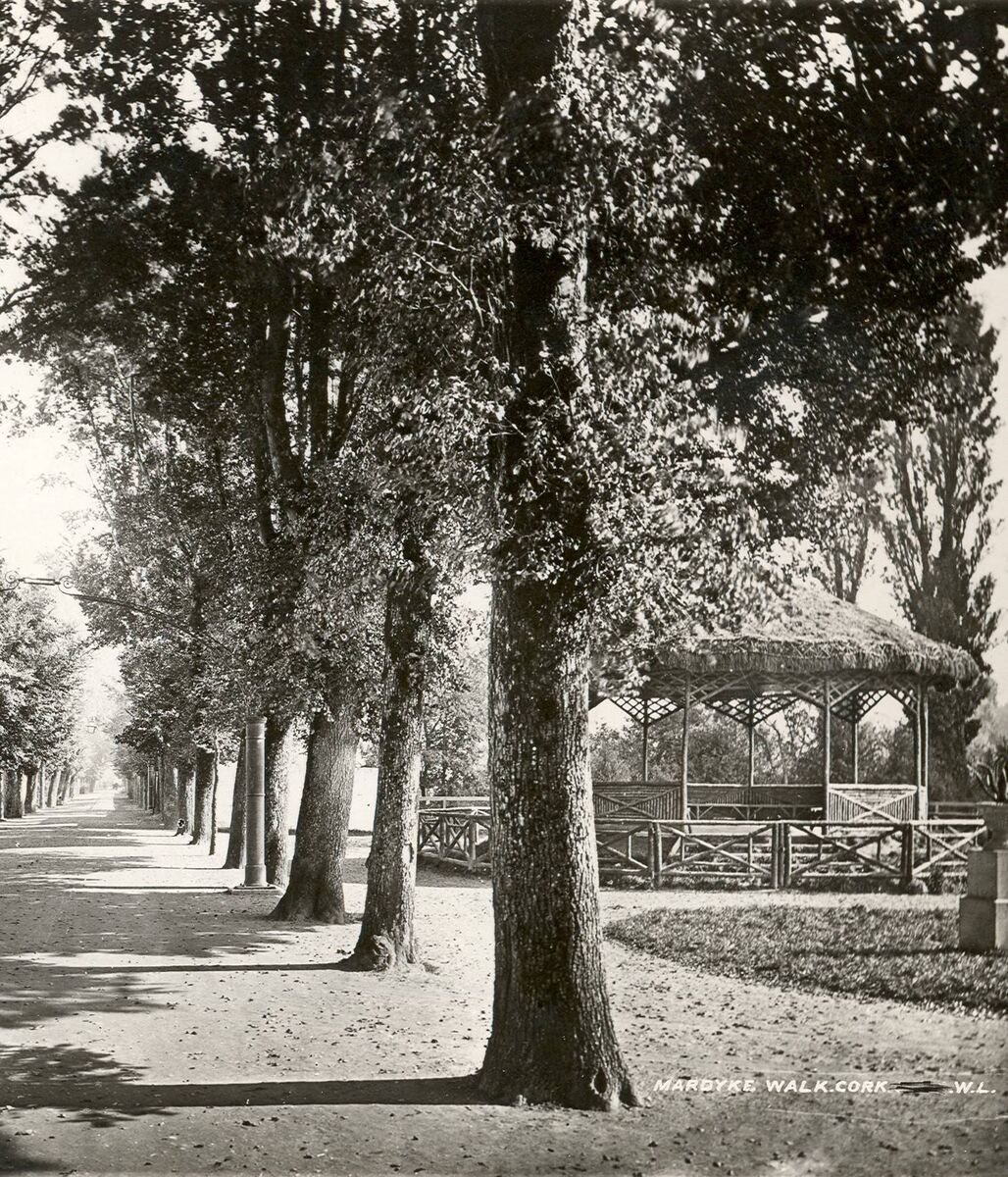
A romantic view of the Mardyke Walk in the second half of the 19th century. On the right, can be seen the wooden Band Stand in the Band Field. In the spring of 1982, after serving the people of Cork for well over a century, work commenced on the Band Field for the two-lane roadway link-up between Western Road and the Mardyke Walk. During its construction, many healthy, stately trees were cut down and rooted-up and wooden seats were removed. In addition, the two-foot-high octagon concrete band platform base, which replaced the old wooden Band Stand in the 1950s, where brass and reed bands entertained generations of music enthusiasts, marched into the archives of the past, leaving the Mardyke without a bandstand. The recitals then had to be rendered by the bandsmen standing against the west wall of the field; and when the roadway was completed at the end of the said year, it ended an era of music tradition on the Dyke. The Band Field and the Mardyke Walk had now become a speedway. Photograph 1: Mardyke Walk, Courtesy: Cork City Library

Other letters of a stronger nature were also sent to the corporation and the local newspapers expressing their profound disgust, not of the bands or their performance, which were of the highest standard, but of the filthy condition of the promenade and the Band Field and the rough element that frequented it on concert evenings.

Public concern

The following extracts taken from letters published in the Cork Examiner, Wednesday, May 24th, 1893, written by concerned citizens, give us a good insight into the state of affairs: The Dyke is certainly not a suitable place for a band now. It was a nice beautiful walk once but since the corporation ignorantly and carelessly allowed it to become a depository for foul-smelling muck the citizens might as well give it over to its fate. We are heartily sorry for those who have to live there... Yours a Citizen.

A writer of another, entitled The City Bands, stressed: ... the Mardyke is a very rough place on band nights, with throwing of grass and mud etc ... Regarding this letter, the authorities acted upon it immediately by having police patrol the walk especially on band recital evenings as many of the city’s military and civilian bands were on the brink of refusing to perform on the Dyke due to the continuing vandalism.

Police patrol walk

Concerning the former letter, the Corporation records tell us that much development was taking place on both sides of the walk in the neighbouring fields, especially on the southern ones with the erection of more private dwellings. In addition, there was a huge increase in human traffic due to band recitals and access to sports amenities. Consequently, the walk was suffering. These issues too were addressed, and at the dawn of the 20th century the eyes of the world were focused on the Mardyke when the 1902–1903 Cork International Exhibition opened there, during which the sweet sound of military and civilian band music filled the air; and that music will fill the air again at the upcoming St Patrick’s Day Precession when Da Barracka and Da Buttera will march, carrying on their grand proud tradition of music.

Sources:

Cork Examiner Files

Cork City Library Files

Richard T. Cooke, Barrack Street Band. Ireland’s Oldest Amateur Musical Institution. Cork, Quality Books, 1992.
More in this section

Cork City Council seeking developer for North Main St eyesore Cork City Council seeking developer for North Main St eyesore
Bid to name scenic West Cork walk in memory of popular local doctor Bid to name scenic West Cork walk in memory of popular local doctor
Books of evidence due on two accused of criminal damage at Collins Aerospace in Cork Books of evidence due on two accused of criminal damage at Collins Aerospace in Cork

Sponsored Content

 EirGrid, ensuring nature thrives in journey to cleaner energy future EirGrid, ensuring nature thrives in journey to cleaner energy future
City Tiles and Bathrooms: Latest trends and timeless colours City Tiles and Bathrooms: Latest trends and timeless colours
Step into nature during National Biodiversity Week Step into nature during National Biodiversity Week
Contact Us Cookie Policy Privacy Policy Terms and Conditions

© Examiner Echo Group Limited

Add Echolive.ie to your home screen - easy access to Cork news, views, sport and more